Friday morning Gib and I jumped into the car and headed off, filled up the petrol tank and ended up... in
The Grampians National Park. It's about 3.5 hours drive from Melbourne - or closer to 4 hours if you forget to take the ring road and end up in
Werribee instead (both driver and navigator got distracted by an interesting discussion on Triple J). It's a favourite destination for both Gib and I, although we've never holidayed there together before. We stayed in the National Park camp grounds because they're dirt cheap - you get drop toilets and no showers, but we were only intending to stay overnight anyway... but it ended up being two nights. We slept in the back of the station wagon: a convenient, portable "tent". Amazingly, the weather was perfectly cold and sunny the whole time we were there. After all the hiking we did, we were quick to leap into the shower when we got home.
 The view out the back of our "tent". There were plenty of kangaroos in the vegetation.
We were a little unprepared: We had gin, tonic water and even limes, but no cups. Cups would have also been useful for the tinned soup we brought. A few extra bottles of water wouldn't have gone astray either, but we managed to make some good camping improvisations by getting water from waterfalls and boiling it for ages. We made pancakes out of tonic water. Perhaps an extra pair of warm pants wouldn't have gone astray either as it was extraordinarily cold at night.
Day one: McKenzie Falls and Briggs Bluff
We stayed at Smith's Mill camp ground, which is stones throw to the McKenzie falls. We sat in the
car park having the classic camping breakfast: bite the middle out of a piece of bread and crack an egg into the middle and fry it up til it's all golden on the outside and gooey on the inside, but we had a hard time fending off a family of 12
carrawongs. We were down at the falls nice and early, about 8am, but still by 8:30 there was a crowd of tourists coming down. The McKenzie falls are far more impressive in winter than summer.
 Breakfast at McKenzie falls
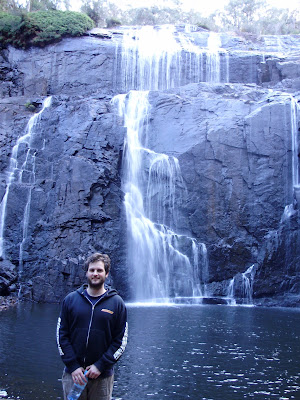 Gib at McKenzie falls
The Briggs Bluff walk was fantastic. It was about 4 hours return (estimated 3.5, but we took a wrong turn). While the view from the top wasn't nearly as breathtaking as other climbs, the walk itself was stunning. The terrain was so varied on the way to the top, starting with Beehive Falls, through forest, large boulders and sandstone, and other parts were open, rocky and swampy.
We were astounded at the number of carnivorous plants we found. Until a few months ago we
hardly knew anything about carnivorous plants. Then after going to just a couple of the Victorian Carnivorous Plant Society meetings for advice on our plants, we learned that there were more than just Venus fly traps and your standard pitcher plants. Just by sitting in on meeting we absorbed information about the local, native species, and while we were in the Grampians we were able to spot them
everywhere. It's amazing what's right under your nose without even knowing. I'm sure I've seen these plants a thousand times and thought they were just another moss or something.

 Various carnivorous plants on the way to the top of Brigg's bluff
On the way to the Grampians we had joked about whether we'd see any
Asterolasia phebalioides, the endangered plant that I picked up and have
struggled to keep. l specimens, about a metre tall, with light green fluffy leaves, looking much happier than mine. I have wanted to see them growing so I can get a better idea on how to better manage my one at home. They're only found in a few pockets around Australia, and only in a handful of places in the Grampians. On the way up to the bluff we saw other
Asterolasia but not the
A phebalioides, but then to my absolute astonishment I found one on the way back. Beautiful, about a metre tall with thick light green leaves, looking much healthier than my one. Then we started spotting them all over the place in an area about 2/3 of the way to the top of the bluff. Coincidentally we'd found the best spot for them. Apparently the area surrounding Beehive Falls is home to the
largest population.
 A healthier specimin of Asterolasia phebalioides
My favourite walk in the Grampians, up until now, has been Mount Hollow. I think that has now been surpassed by the walk up Mt
Stapylton. The entire way along the walk is totally amazing: there are beautiful, sheer rock faces and stunning views the whole way. It's easy to navigate and the first part is a flat surface but quite steep, and then it sweeps down to an easy forest track. You walk past the
Taipan Walls which are spectacular orange cliffs, through more shrubbery and then climb up some rocks to the first ledge. I was thinking at this point that it wasn't so bad, what are all of the reviews talking about when they say that people never make it to the top? It's at this is the point in the track where the yellow markers end and the red markers begin.
The red section of the track isn't so much physically challenging (it's
definitely tougher but there are plenty of knobbly rocky hand holds) but it's a test of your mind. We took the red arrow to the left, which leads you across a couple of very precarious ledges. The first was about a foot wide and then you have to climb up through a narrow hole onto another rather precarious ledge which is a bit less than a foot wide and much more exposed. My toes are going numb just writing about it now. There's a nice flat
rock face angling back that you can cling to for your life and eventually you reach a rocky outcrop with some rock pools. I don't particularly
like heights, but this was the first time I've felt
physically ill from heights. I think I could have coped better if there wasn't so much wind. I looked up and there was one short, final scramble to the top. It was steep and even more exposed. The hair raising experience on the previous ledges had totally done my head in and I just could not bring myself to do the last bit. I sat admiring the stunning view in a tight ball of petrified mess, wondering how on earth I'd make it down. Gib leaped like a mountain goat to the top, took videos and everything (bastard). He tells me that the ledges were much harder and that the last section is quite easy: just climb up through some
nobbly rocks and you're there.
Will I do it again? Absolutely!
 The track leading to Mt Stapylton peak. The orange cliffs are the Taipan walls, a popular place for rock climbing.
 Me, freaking out, not far from the final ledge near the peak. The narrow path below me is about 2 meters wide at that point. The trees behind me are a couple of hundred meters below me (refer to picture above - you can see where the line of trees are below the shelf that I'm on).


.jpg)


